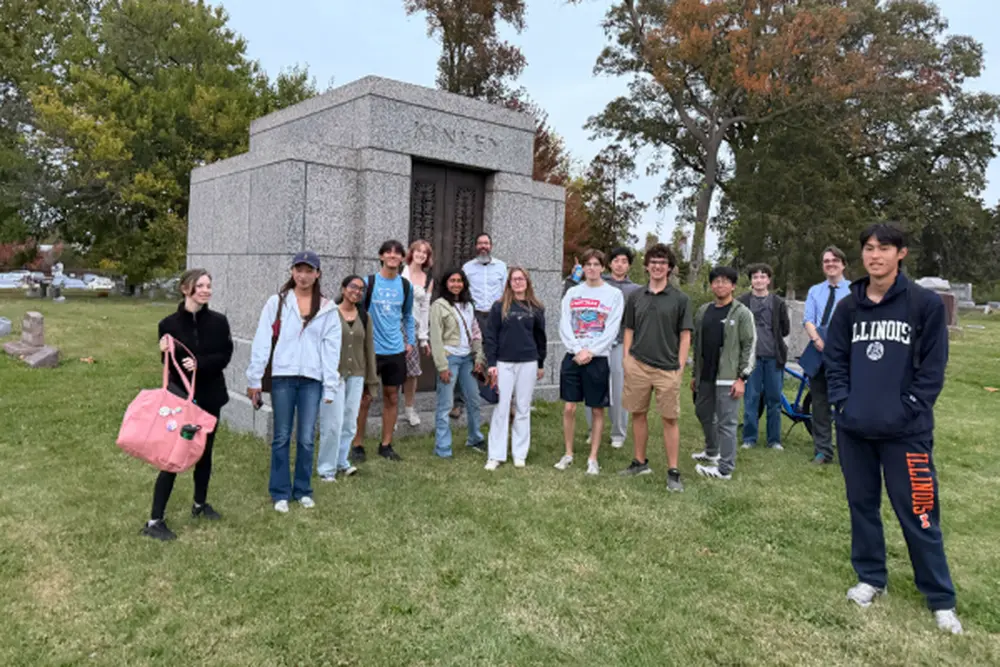
Is there a better way to celebrate Halloween than in a cemetery, spending time with the ghosts of university leaders past?
Well, that’s exactly how several economics students and professors decided to ring in the spooky season this year, launching what they hope will become a new tradition: the David Kinley Grave Walk.
This autumn outing was the brainchild of professor Isaac DiIanni, who envisioned it as a way for economics students to connect with one another and the rich history of the university the University of Illinois Urbana-Champaign.
The walk celebrated the legacy of two influential figures in the university’s history: John Milton Gregory, the university’s first regent from 1867–1880, and David Kinley, an economist who later served as university president from 1920–1930.
Gregory’s tenure as regent began when University of Illinois Urbana-Champaign was first founded. In those days, the university was known as the Illinois Industrial University and was one of only 37 public land-grant institutions in the country.
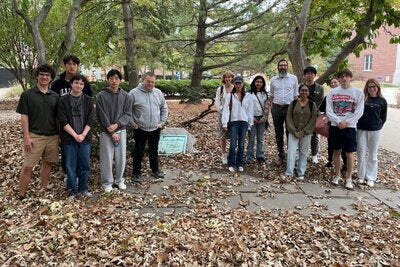
Located under the canopy of a large tree in a quiet memorial grove next to Altgeld Hall is Gregory’s final resting place. It’s the only known gravesite on campus and still many pass it without ever knowing it’s there, making it the perfect starting point for the David Kinley Grave Walkers. The serene spot offered the group a moment to reflect on the university’s earlier years and the leaders who helped shape its future.
“It’s fun to think about what campus must have been like for students and professors back in those days and think about how things might be in the future,” said economics professor and grave walker Bryan Buckley.
After observing Greogry’s final resting place, the group made their way down the Main and South Quad’s golden, tree-lined paths. Campus was at its autumnal best with the sound of crunching leaves underfoot and conversation following the group as they headed to Mount Hope Cemetery to visit the final resting place of U of I’s sixth president and founder of the Department of Economics, David Kinley.
Many campus greats are buried in the historic cemetery, which is an expansive swatch of land that sits just south of campus near Gies Memorial Stadium at Fourth Street and Kirby Avenue.
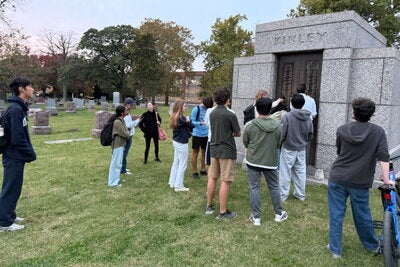
After their mile long trek from Altgeld Hall, the grave walker’s work wasn’t done. They weren’t sure of the exact location of Kinley’s grave, so they traipsed through the cemetery, scanning the names on headstones as dusk quickly approached. Luckily, Kinley’s grave was hard to miss.
Tucked away on the west side of the cemetery, a striking mausoleum poked out of the landscape. Kira Trapkus, a member of the Class of 2028 majoring in economics and minoring in business, happened upon it first and noticed the name “Kinley” etched at the top.
After paying their respects, many of the grave walkers stuck around and chatted until dark. Much of the conversation surrounded ways to build upon this experience for next year to continue this tradition.
“I really enjoyed walking with fellow economics students in a niche new tradition!” said Trapkus. “I’m excited for future walks that will hopefully bring more participants. I hope we can carry candles at the next walk. I think it would add a spookier, romanticized element to the walk.”
To further honor Kinley, DiIanni read a letter from the archives that was written by a former student of Kinley’s to wish him a happy 80th birthday in 1941. The letter underscored not just Kinley’s impact on campus, but also the individual students whose lives he shaped.
“I am so happy that students had a chance to connect with each other and also with the department’s own history, so they can see that they’re a part of a great Illinois story that’s over a century old!” said DiIanni.
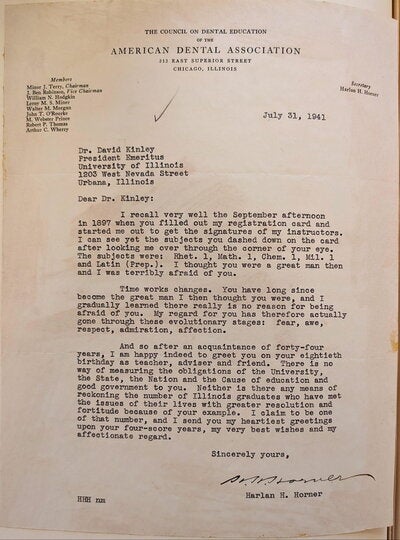
Dear Dr. Kinley:
I recall very well the September afternoon in 1897 when you filled out my registration card and started me out to get the signatures of my instructors. I can see yet the subjects you dashed down on the card after looking me over through the corner of your eye. The subjects were: Rhet. 1, Math. 1, Chem. 1, Mil. 1 and Latin (Prep.). I thought you were a great man then and I was terribly afraid of you.
Time works changes. You have long since become the great man I then thought you were, and I gradually learned there really is no reason for being afraid of you. My regard for you has therefore actually gone through these evolutionary stages: fear, awe, respect, admiration, affection.
And so after an acquaintance of forty-four years, I am happy indeed to greet you on your eightieth birthday as teacher, adviser and friend. There is no way of measuring the obligations of the University, the State, the Nation and the Cause of education and good government to you. Neither is there any means of reckoning the number of Illinois graduates who have met the issues of their lives with greater resolution and fortitude because of your example. I claim to be one of that number, and I send you my heartiest greetings upon your four-score years, my very best wishes and my affectionate regard.
Sincerely yours,
Harlan H. Horner
Editor's note
The letter above is reproduced as written.