While many professors struggle to get students into office hours, economics professor Isaac DiIanni barely has enough seats for everyone at his.
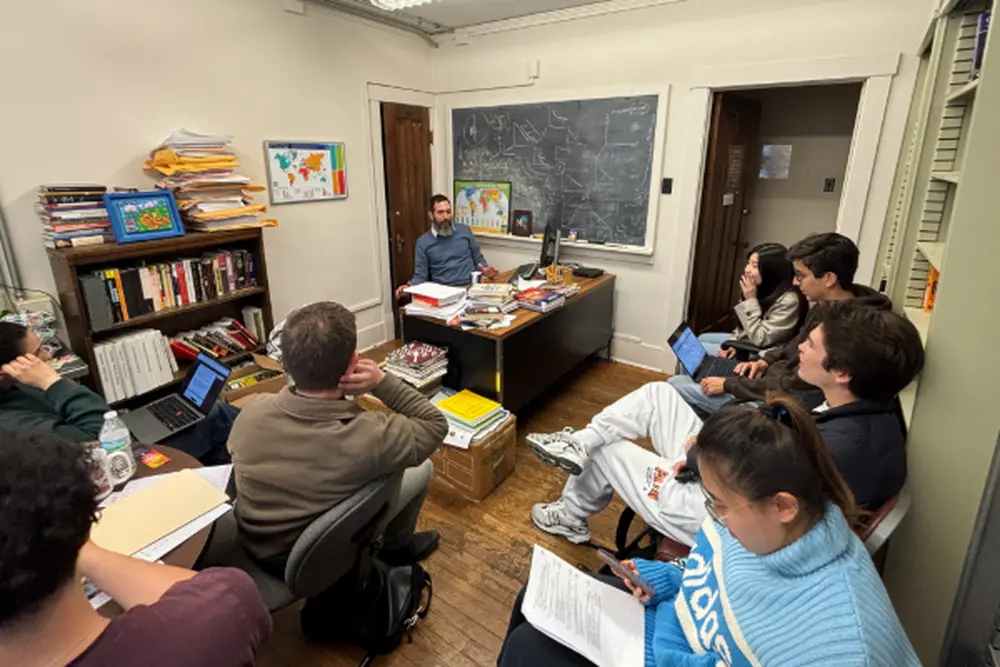
On Tuesday afternoons, you'll find his small office packed with students.
They come and go as they please. Some work quietly at a table on one end of the room, while most settle into a Socratic-style semicircle around DiIanni's desk, eager to ask questions and exchange ideas with him and one another.
Their eagerness is understandable. DiIanni is a fascinating person, a renaissance man with no shortage of interests to discuss. He enjoys collecting lightbulbs, making soap, and woodworking. He's also something of an archivist, with a collection of old newspapers, wartime copies of the Illio, and University of Illinois Urbana-Champaign commencement programs.
He's just as interested in learning from his students as they are in learning from him, which might be why many have become regulars and return week after week to discuss everything from economics to politics, history, and culture.
"Honestly, the best office hours ever," shared Helen Wu, Class of '26, computer science plus economics. She's a regular on Tuesdays. "I come here to study sometimes and treat the conversations like a podcast. I love that students just gather and talk freely—the range of topics is always surprising."
"The first time I went to office hours, I stayed for three or four hours," said junior Salma Rojano. "It's so interesting to hear other students debate ideas with him. Everyone approaches the conversation with an open mind, seeking to understand each other and be understood."
Rojano started at U of I as a mechanical engineering major. After taking a couple of DiIanni's courses and attending office hours, she decided to add a second major in economics. She said that his passion for economics makes it easy to learn from him.
"He has a very straightforward style—he's clear and concise. I enjoy hearing his thoughts about random issues or theories that he presents in class. Seeing how a concept can be applied outside of the classroom makes everything engaging."
DiIanni's students clearly admire him, and it's easy to understand why. The award-winning instructor has cultivated a warm, welcoming environment in his office hours.
"I think students like that they can ask anything they want here; there's not going to be judgment about what they want to discuss," he explained. "All are welcome."
He isn't kidding when he says all are welcome to come chat. Students who aren't in his class, or any economics class, have been known to attend.
"For some reason, I've encountered a lot of astronomy students over the years," he laughed. "They always have great physics examples. Their background in the natural sciences makes them approach the social sciences from a different angle than I would, so I really enjoy hearing their insights."
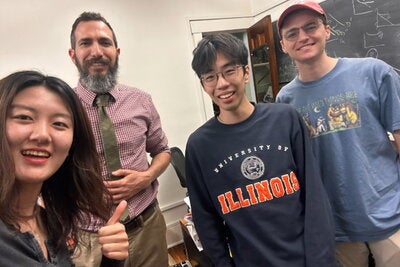
DiIanni recalled an astronomy student who was a regular at office hours a couple of years ago. She found out about them through a friend, a mechanical engineering major, who crashed DiIanni's lecture one day.
"I guess he found the class interesting because he stayed the whole time and had all these questions afterward," DiIanni said. "I didn't recognize him, so I asked if he was in the class. He said no, and I told him he should bring his questions to office hours so we could talk about them there."
Getting to have these far-reaching conversations with students from different disciplines is exactly why DiIanni's office hours are open to all. Each conversation is a chance to encounter a new perspective.
"I'm happy to have my office flooded. I want students, no matter who they are, to know that there is a space for people to have those conversations if they want."
Students discover DiIanni's office hours in many ways, but most hear about them from a friend and decide to give them a try.
"During my lectures, I invite students to come chat about economics. I'm sure they think, 'What is there to chat about?' As it turns out, there's a lot!" he said. "Are you frustrated by the Champaign rental market? Annoyed that concert tickets cost so much? Having conflicts with a roommate? Come by and let's talk about it."
Learning from a mentor
DiIanni was intentional in creating this fluid, conversational forum for students. He was inspired by Tom Rustici, a professor at George Mason University, for whom he served as a teaching assistant in graduate school. Rustici held his office hours in a similar way.
DiIanni recalls how students lined up outside of Rustici's office for the chance to chat with him. As Rustici's TA, DiIanni got a front-row seat for those conversations with students.
"It was inspiring to think that one day I could be on that side of the desk, hearing all these fascinating questions," he said. "I thought, if this is what this job can include, then I am always going to include it."
Rustici's influence carries into DiIanni's teaching style, too.
"Tom was just amazing," reflected DiIanni. "He had the ability to weave a fascinating lecture by combining economics material, which can sometimes be a bit dry to students, with more 'red meat' topics, making it more interesting and memorable. I thought that was just masterful."
DiIanni says he stole a lot of Rustici's analogies and references for his own classes. When he mentioned this to him, it turned out that Rustici had taken that same material from one of his professors, who had taken it from one of his professors, and so on.
"I don't even know where some of these specific examples or turns of phrase originated from—it could have been from academic generations earlier. I can't give proper credit for everything, but neither could Tom," he joked.
Talk to any of DiIanni's students and the similarities between him and Rustici become striking. They describe his ability to make mundane lectures interesting and the creative ways he presents ideas.
Alumna Anastasia Calkins (BA, '24, economics) found DiIanni's lessons in class memorable and useful beyond graduation.
"His ability to teach foundational ideas in a way that truly sticks with students has been incredibly impactful, and I continue to draw on those concepts in my legal studies today," she said. "During my first year of law school, I read an opinion that referenced the invisible hand theorem, and I reached out to Professor DiIanni immediately after class; I was excited to see an economic concept from his course applied within a legal framework."
Making economics—and everything else—matter
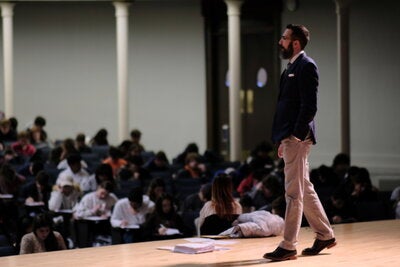
DiIanni's ability to make course concepts engaging proves especially useful as he teaches ECON 102: Microeconomic Principles, an introductory course that is at the core of the economics curriculum, and many non-majors take it as well, making it one of the largest lectures on campus, and students' first taste of the discipline.
For this course, DiIanni is typically lecturing to roughly 900 students from the stage of Foellinger Auditorium.
The size of the lecture and the task of balancing the needs of economics majors and non-majors could be a challenge, but DiIanni makes the material accessible without sacrificing rigor.
"I think lecture-based instruction still plays a central role at the college level," he explained. "This is truly the best way to teach micro- and macroeconomic principles. At that level, students don't know anything about economics, so it's not the time for discussion; it's the time for us to build a foundation of knowledge."
DiIanni views these courses as fundamental to students' intellectual development. They're about giving students an economic way of thinking that they can build on throughout college, regardless of what they study.
"Even if they never use a supply-and-demand graph again, they're learning a way of analyzing the world," he said. "Concepts like opportunity cost, incentives, and marginalism apply to so many different aspects of life beyond what we think of as strictly economic topics."
Seeing that mindset take hold in students is one of the best parts of the job for DiIanni.
In addition to ECON 102, DiIanni also teaches ECON 302: Intermediate Microeconomic Theory and ECON 402: American Economic History, so he gets a front row seat to students' intellectual growth.
"It's fun to watch students learn about supply and demand for the first time and then, a few years later, discuss subtle differences between economic models and apply economic thinking to a wide range of topics," he said.
DiIanni explained that teaching isn't just a skill, it's a mentality. Commitment to student growth is grounded in what DiIanni calls intellectual empathy. As an instructor, he tries to remember what it's like not to know something and to meet students where they are in the learning process.
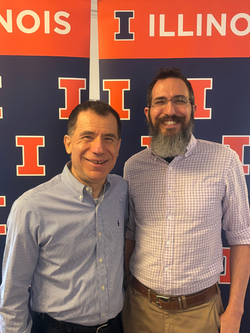
"It's really just about remembering what it's like not knowing something," he described. "It's a type of empathy, intellectual empathy. Developing that sense for talking with people is really enriching to your own life, too, because it gives you a better appreciation for what other people are doing and thinking, and why."
Even though teaching seems to come naturally to him, DiIanni never planned to become a teacher. After graduating with a degree in economics and landing his first job, however, he found himself spending much of his workday reading about economics.
"I had economics books stashed in my desk drawer, and read them when my boss wasn't looking," laughed DiIanni. "I realized that wasn't sustainable. So, I decided to find a job that involves reading about economics, which led me back to school for my PhD."
All this eventually led him to the University of Illinois in 2012, where he has built a reputation as a dedicated teacher and mentor. He received the Award for Excellence in Undergraduate Teaching from the Office of the Provost in 2019, and in 2026, students in ECON 102 named him an Equity Champion Instructor.
"Isaac is an undergraduate mentor par excellence," said George Deltas, chair of the Department of Economics. "His students do not just get a top-quality instructor. They get an immersive experience into economics that goes beyond the classroom. For many, it changes the way they view the world and has a major impact in their lives."
The recognition is meaningful, DiIanni said, because it reflects the relationships he has built with students and colleagues over the years.
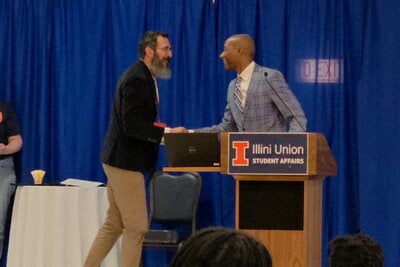
"Even though this is a large flagship university with world-class research faculty, we also have a strong intellectual community at the undergraduate level," he said. "There's a real culture here of discussion, mentorship, and curiosity that extends beyond the classroom."
For DiIanni, the most rewarding moments still happen on Tuesday afternoons, when students crowd into his office to ask questions, debate ideas, and learn from one another.
After all, that's what drew him to teaching in the first place.
"Everybody is up to something cool," DiIanni said. "Whether an astronomy, engineering, theatre, or economics student walks into my office, I know I'm going to learn something that day. Why on Earth would I turn them away?"