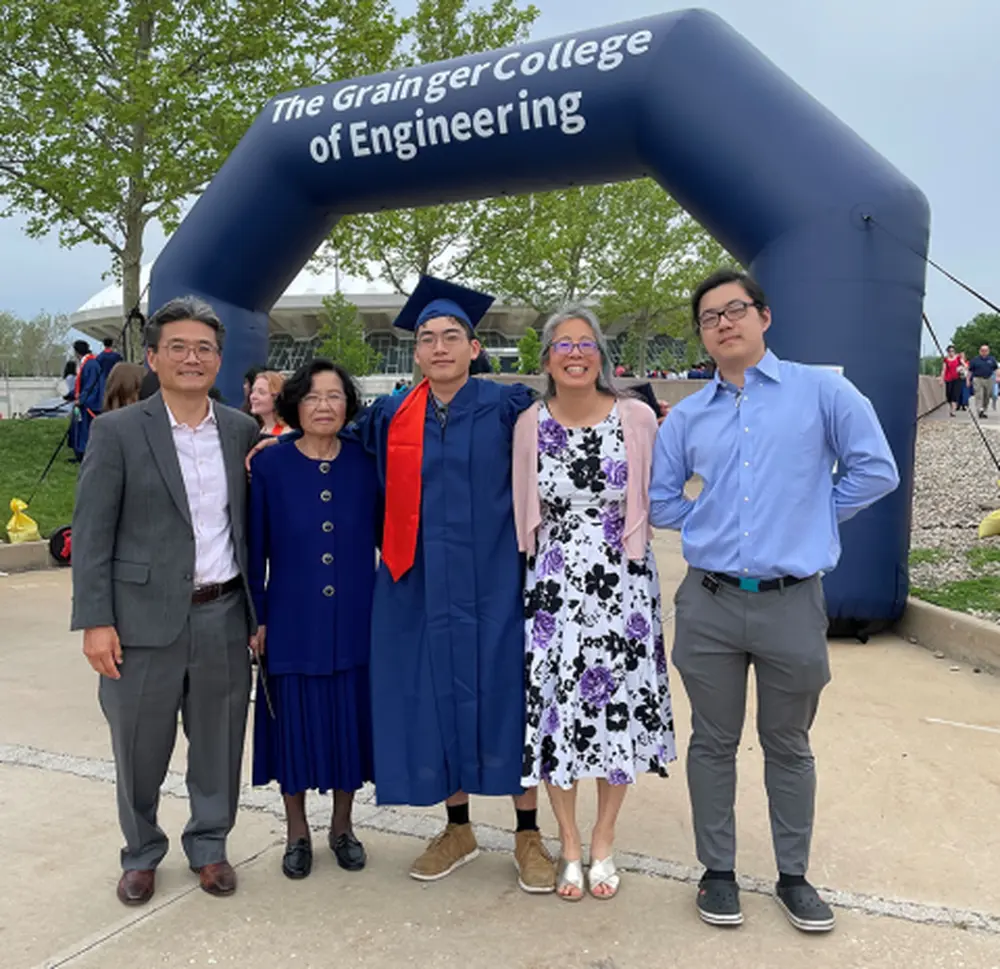
If you were a student on the University of Illinois campus in the late 80s/early 90s, there is a chance you would have seen Dan Shin (LAS ’91) studying in the School of Music lobby. “I found it an easier place to concentrate than the library, and I had this fondness for that little lobby,” he said of the space where he frequently reviewed notes before exams, sitting quietly while the sounds of rehearsing student musicians filled the hall.
A self-described “hardworking, hardcore student,” he double majored in honors biology and economics. “I hit the books constantly,” he said. At one point he considered becoming an economist, but ultimately decided to follow his initial aspiration of attending medical school. Today he is an infectious disease specialist in Mountain View, California.
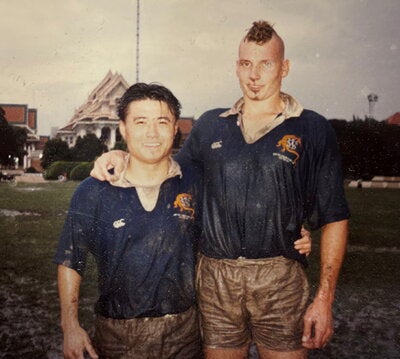
after a match.
As a student he was not only driven to succeed academically but also followed his curiosity for all aspects of the human experience, which proved to be equally formative and helped to shape his worldview.
He read widely—mostly novels—outside of class. Then there was club rugby, where he learned the values of physical and mental sacrifice, teamwork, and camaraderie on muddy fields.
He was among the crowd at The Replacements and the Sun Ra Arkestra shows at Foellinger Auditorium and U2’s 1987 Assembly Hall performance. He even spotted U2 lead singer Bono walking alone on Green Street the morning after the band’s concert and infamous surprise visit to the Delta Delta Delta house (see the photos). Shin thanked Bono, who had lost his voice but was friendly, shook his hand, and walked on. “My jaw dropped,” he said.
Shin made frequent visits to Krannert Center for the Performing Arts and Krannert Art Musuem, where he saw a performance that left a deep impression. “One of the master’s students did a mesmerizing dance with a spoon in her hand. It was only six or seven minutes, but it was breathtaking and emotionally overwhelming,” he said. “I remember thinking: ‘Why am I getting so worked up about a young woman dancing with a spoon?’”
A couple of decades after those formative student years, Shin was approached by Illinois gift officers who had noticed that a California physician alumnus had been generously giving to departments and programs across campus, including the arts and the library. He remembers early interactions with Trent Reed, and then Tony Pomonis and past HRI director Antoinette Burton, as his first connections to the humanities.
What resulted was a sponsorship of visiting speakers to HRI, which has since included talks by Rice University professor Kirsten Ostherr, who presented on translational humanities responses to the coronavirus, Yale professor Kalindi Vora, who spoke about ethnographic research of chronic pain patients, and the Kinsey Institute’s executive director Justin Garcia, who discussed the history and future of the storied institute. All of the talks showcase researchers who are working at the intersection of the humanities and science, topics that have drawn attendees from all corners of the campus.
For Shin, a deep understanding of what it means to be human is essential to his work as a physician. “In my job, I rely a lot on data every day. In fact, today I'll be looking at numbers, CAT scans, lab results, and MRIs,” he said. “And what's interesting about medicine, and I think most fields, including engineering, is that you have to rely on the data and use it, but then you have to step aside for a second and say: ‘What are the things I haven't thought of? What are the ethics of what I'm going to do right now? What is the life philosophy of the patient or the family?’ You don't know that until you ask them. You have to have a conversation with them and ask, ‘What is important to you?’”
In addition to considering the individual, Shin believes in the importance of connection to the greater community. In fact, his support made it possible for HRI and We CU to launch the Humanities in Action (HIA) program five years ago. HIA is a community engagement initiative that matches humanities undergraduates with community partners to collaborate on a project addressing an important local need. HIA scholars have worked with organizations such as Immigrant Services of Champaign-Urbana, Solidarity Gardens, the Education Justice Project, and Strides Shelter.
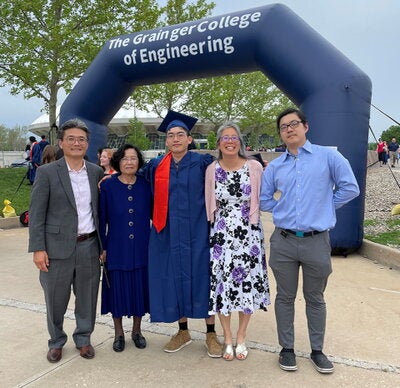
grandmother Young Hee Shin, Owen, mom Alys, and older
brother Noah.
Shin said he was excited to give to a program where students would be able to get paid while doing work that is hands on and would make a difference locally. “I think it’s just as impactful and germane to the humanities as writing a book or giving a talk, so I wanted to support that.”
It makes sense, then, that Shin has expanded his giving to HRI’s Odyssey Project, a program that offers free credit-bearing Illinois courses in the humanities to income-eligible adults in East Central Illinois. Now in its twentieth year, Odyssey is an accessible way for local adults to experience higher education, whether for the first time or after a long absence from the classroom. Shin’s support of Odyssey has helped to pay for classroom books and supplies, field trips, and more.
“If you go to some of the bigger campuses around the U.S., which I have been to, sometimes the areas surrounding the school are destitute,” he said. “So, I think it's a matter of saying ‘Well, let's do something to enrich the community in which we live.’ Rather than just being a university for the world, how about being a university for the people who live here?”
Shin returned to campus in December 2025 for his son Owen’s graduation (he holds two degrees in electrical engineering). Visiting campus—now as the parent of a student—was fun but also jarring at times. “Some of my favorite restaurants and bars have closed,” he said. And while places like Mabel’s may be gone, and Assembly Hall renamed, Shin continues to carry with him the imprint of all of those past adventures. Because of his loyal support, many students are able to engage more deeply in their own journeys, too.
Editor's note
This story was originally published on the Humanities Research Institute site. It was written by Erin Ciciora, assistant director for communications.