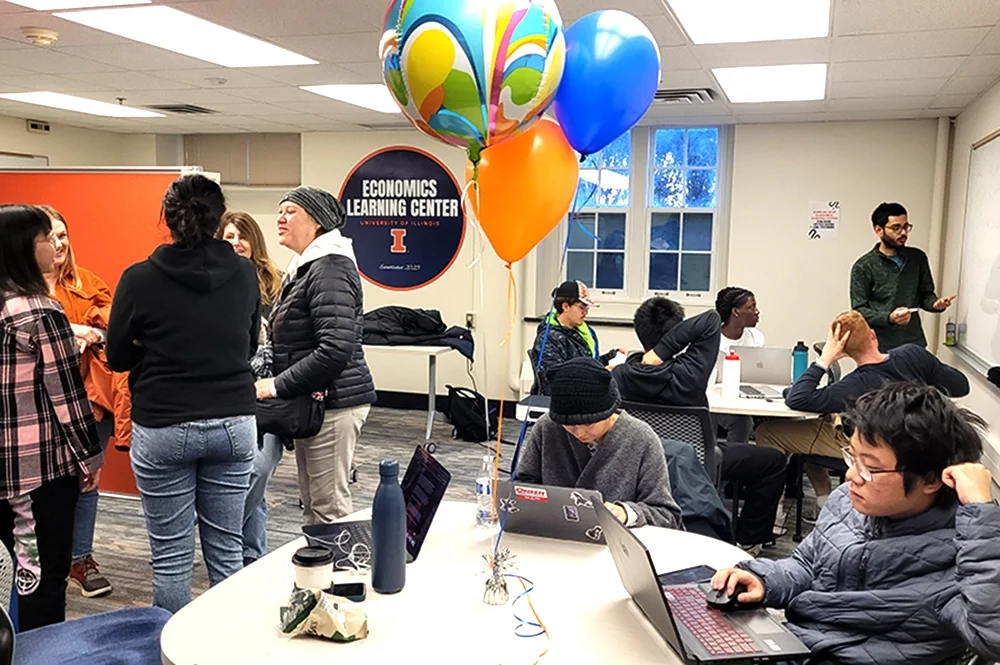
The Raphael Kiam Economics Learning Center was recently renovated to be more inviting and accommodating to students.
Located in the lower level of David Kinley Hall, the ELC is a space for economics students to receive tutoring and study. Before the renovations, it was a dark room with limited seating options.
“The space was really in need of an update,” said Jamie Thomas-Ward, director of undergraduate studies for the Department of Economics. “We wanted it to be a much more comfortable, inviting space.”
Katie Kennealy, associate director of career and alumni affairs, said that the space—formerly called the Economics Tutoring Center—had long been targeted for renovation, but funding was a challenge. With help from the LAS Office of Advancement, however they obtained support from alum Raphael Kiam (BA, ‘01, economics), a consistent supporter of the department.
“We were delighted to learn that Mr. Kiam deeply valued his undergraduate experience and was enthusiastic about contributing to the transformation of the space,” Kennealy said. His support led to the establishment of the Raphael Kiam Economics Tutoring Center Support Fund, which made it possible to renovate the existing Tutoring Center and ultimately develop what is now the Raphael Kiam Economics Learning Center.
Most of the funding was paid for by Kiam, with the remainder paid for by the Department of Economics.
“He specifically designated his donation to be used for this purpose, which was fantastic,” Thomas-Ward said. “I’m thrilled that the donor really found that undergrad space to be a priority.”
The space is used for independent and group studying. Teaching assistants, like Rebecca Moore, use the space for office hours.
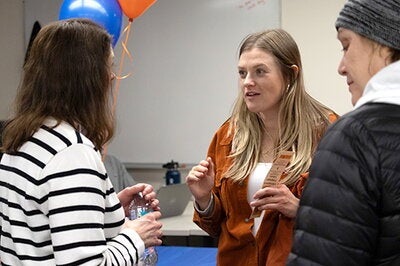
“While it is not a huge space, the upgrades make it possible to accommodate more people,” Moore said. “We have more whiteboards, which also act as partitions allowing us to divide into smaller groups. The tables move around to accommodate different group sizes too.”
That flexible furniture was a priority in the renovations because of the different ways the space is used, Thomas-Ward said. During office hours, tutors can bring the tables together
to work with a larger group. For those studying on their own, they can use the smaller tables.
“We see that happening now, which is great,” Thomas-Ward said. “We’re seeing a lot more students use the space for small groups.”
Having this designated space for undergraduate study is important.
“The design of the building is kind of two hallways,” Thomas-Ward said. “It makes it challenging to create spaces for people to study.”
She added that the renovations seem to have made an impact.
“Students who maybe in the past would just come for a quick tutoring session are now coming back and spending more and more time in the space for studying,” Thomas-Ward said.
In addition to the new furniture, Thomas-Ward said the room is much brighter now, making it more inviting. Moore said the room feels fresh.
The renovation started in June. The room was stripped down to a cement floor. The furniture arrived in September. In November, the department held an open house for the ELC. When hearing about the open house, Moore stopped by to grab a celebratory cookie and see how the room had changed.
“It really feels like a whole new space,” Moore said.
During the open house, the different uses of the ELC were already visible. Gathered around a circle table, a group of students watched a tutor walk through a problem on a whiteboard. On the other side of the room, students spread out to study individually.
“I hope that this signals to students that undergrad spaces for them to study and get academic support is a priority,” Thomas-Ward said. “It’s important to us. It’s important to our alumni.”