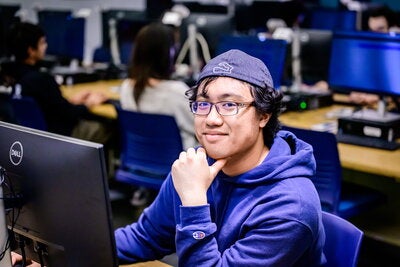
Technology and economics increasingly shape the way organizations, markets, and societies operate. The Bachelor of Liberal Arts (BSLAS) in Computer Science plus Economics (CS + ECON) at U of I brings these two powerful disciplines together, giving students the tools to develop innovative technologies and understand their economic impact. By combining rigorous training in computer science with economic reasoning and quantitative analysis, students learn to transform data into insights, evaluate complex decisions, and solve real-world problems. This STEM-designated degree will prepare you for a wide range of careers at the intersection of technology, business, finance, and government decision-making, with the adaptability to thrive in a rapidly changing economy.
Learning Outcomes
Analytical Problem-Solving
Economics students will effectively visualize, conceptualize, articulate, and solve complex problems or address problems that do not have a clear answer, with available information, through experimentation and observation, using microeconomic and macroeconomic theory, as well as calculus and statistical tools.
Critical Thinking
Economics students will apply economic analysis to everyday problems helping them to understand events, evaluate specific policy proposals, compare arguments with different conclusions to a specific issue or problem, and assess the role played by assumptions in arguments that reach different conclusions to a specific economic or policy problem.
Quantitative Reasoning
Economics students will understand how to apply empirical evidence to economic arguments. Specifically, they may obtain and/or collect relevant data, develop empirical evidence using appropriate statistical techniques, and interpret the results of such analyses.
Specialized Knowledge & Application
Economics students will develop deeper analytical, critical, and quantitative skills in specialized areas by applying economic concepts to real world situations.
Global & Interdisciplinary Perspective
Economics students will broaden their global and disciplinary knowledge, enhancing their understanding of the world around them both within economics and beyond.
Communication & Leadership
Economics students will build skills to work as part of a team and lead others, ensuring they are prepared to navigate diverse audiences and situations.