
BSLAS in Econometrics & Quantitative Economics

Image
A student writes on a whiteboard while studying in the Grainger Library.

In an era where data drives decision-making, economists need more than theory alone. The Bachelor of Science in Liberal Arts (BSLAS) in Econometrics & Quantitative Economics is a STEM-designated degree that blends economic reasoning with advanced quantitative analysis, giving students the tools to uncover patterns, test ideas, and solve real-world problems using data. Through a rigorous curriculum in economics, statistics, and mathematics, students learn how to transform information into insight and evidence into action.

Analytical & Problem-Solving Skills

Economics students will effectively visualize, conceptualize, articulate, and solve complex problems or address problems that do not have a clear answer, with available information, through experimentation and observation, using microeconomic and macroeconomic theory, as well as calculus and statistical tools.

Critical Thinking

Economics students will apply economic analysis to everyday problems helping them to understand events, evaluate specific policy proposals, compare arguments with different conclusions to a specific issue or problem, and assess the role played by assumptions in arguments that reach different conclusions to a specific economic or policy problem.

Quantitative Reasoning

Economics students will understand how to apply empirical evidence to economic arguments. Specifically, they may obtain and/or collect relevant data, develop empirical evidence using appropriate statistical techniques, and interpret the results of such analyses.

Specialized Knowledge & Application

Economics students will develop deeper analytical, critical, and quantitative skills in specialized areas by applying economic concepts to real world situations.

Interdisciplinary Knowledge, Diverse Issues, & Global Perspective

Economics students will broaden their global and disciplinary knowledge, enhancing their understanding of the world around them both within economics and beyond.

Communication & Leadership

Economics students will build skills to work as part of a team and lead others, ensuring they are prepared to navigate diverse audiences and situations.
BSLAS in Econometrics & Quantitative Reasoning Requirements

To obtain a BSLAS in Econometrics & Quantitative Economics, students must complete 64-66 hours of required major and supporting coursework and the campus General Education Requirements.

Economics Core (43 hours)

  • ECON 102: Microeconomic Principles (3 hours)
  • ECON 103: Macroeconomic Principles (3 hours)
  • ECON 198: Economics at Illinois (1 hour)
  • ECON 202: Economic Statistics I (3 hours)
  • ECON 203: Economic Statistics II (3 hours)
  • ECON 302: Inter Microeconomic Theory (3 hours)
  • ECON 303: Inter Macroeconomic Theory (3 hours)
  • Eight advanced ECON 300- or 400- level courses (11 hours)
  • 400-level quantitative economics courses (12 hours)

Mathematics, Statistics, & Computer Science Core (15-16 hours)

  • MATH 220: Calculus or MATH 221: Calculus II (4-5 hours)
  • MATH 231: Calculus II (3 hours)
  • MATH 225: Introductory Matrix Theory (2 hours)
  • STAT 385: Statistics Programming Methods (3 hours)
  • CS 105: Introduction to Computing (3 hours)
Image
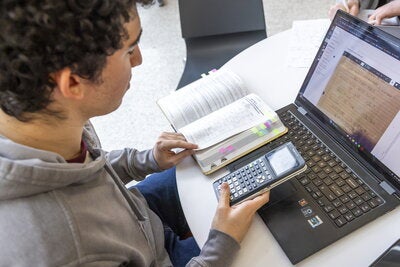
A photo taken over a student's shoulder as they use a calculator to solve a problem.

Supporting Coursework

Make your degree your own. Supporting coursework allows you to explore a complementary field, develop specialized expertise, and tailor your degree to your future goals.

Six hours of courses outside economics, but related to econometrics, quantitative economics, computational economics, or mathematical economics are required. This includes additional courses in mathematics, statistics, computer science, or Quantitative Reasoning II designated courses.

Other quantitative courses will be accepted based on the content and connection with the major. Sime additional areas may include informatics, various fields of engineering, information science, and other areas related to statistical, mathematical, or computational techniques. Supporting coursework must be approved by an economics academic advisor.

Requirements

Supporting coursework must:

  • Include six hours of quantitative coursework at any level in areas relevant to the major. Areas can include STAT, CS, MATH, INFO, QRII General Education requirement, or other areas as approved by an economics advisor.
  • Be completed for a letter grade.

Transfer Credit

Transfer courses may be used toward the requirement, including courses that appear as CR or TR on your transcript, provided they are articulated at the 100-, 200-, 300-, or 400-level.

Courses that Do Not Count

The following may not be used toward supporting coursework:

  • No MATH or STAT courses that fulfill an economics requirement, such as STAT: 385, CS: 101/105/124, MATH: 220/221/231 or MATH: 225/415, or any other courses you are using as a substitution.
  • Composition I
  • Seminars
  • Independent study courses

Language Courses

Language courses may be applied only at the fifth level or above.

Advanced Hours

Econometrics & Quantitative Economics majors must complete 23 hours of advanced coursework on campus to graduate. Please note, ECON 199, ECON 398, and ECON 399 do not count towards advanced economics hours.

Econometrics & Quantitative Reasoning Major Declaration Requirements

CourseRequirement

ECON 102: Microeconomic Principles

ECON 103: Macroeconomic Principles

ECON 202: Economic Statistics I

ECON 203: Economic Statistics II

  • Grade of C+ or better in each course
  • At least one ECON course must be taken at the University of Illinois Urbana-Champaign
  • AP/IB/Proficiency Credit accepted
  • Approved substitutions may be used for Econ 202
  • Transfer courses may be used

MATH 220: Calculus I

MATH 221: Calculus I

  • Grade of C+ or better
  • AP/IB/Proficiency Credit accepted**
  • Transfer courses may be used


**No other substitutions accepted; C+ Grade Required

Students must meet the above requirements in order to declare the major. No exceptions or additional substitutions will be made, and there is no petition if below the requirements.

Intercollegiate Transfer (ICT)

For information about changing your major or completing an Intercollegiate Transfer (ICT) into the College of LAS as an economics student, visit the LAS Declaring website.

Image
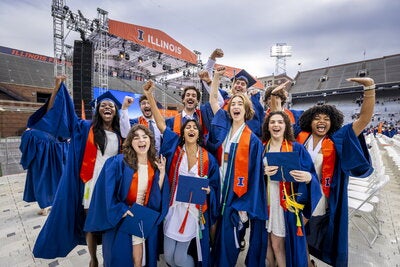
A group of students cheer in their caps and gowns as they celebrate graduation at Gies Memorial Stadium.

Departmental Distinction

Students who meet certain requirements may graduate with Department of Economics Distinction. Every semester we have a small number of students who graduate with this honor, and these students are noted in our May ceremony program and invited to our undergraduate awards and recognition banquet in the spring.

Learn more about the Economics Honors Program